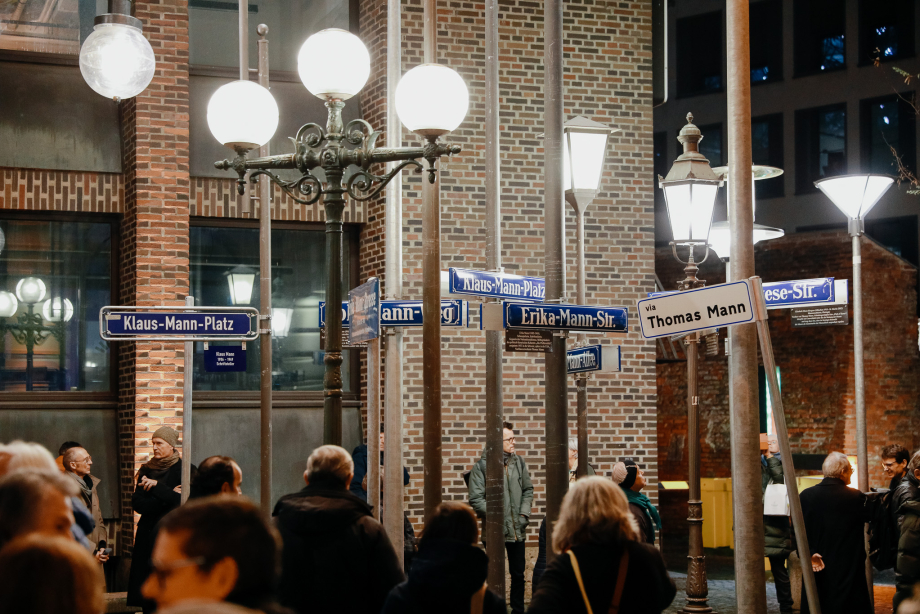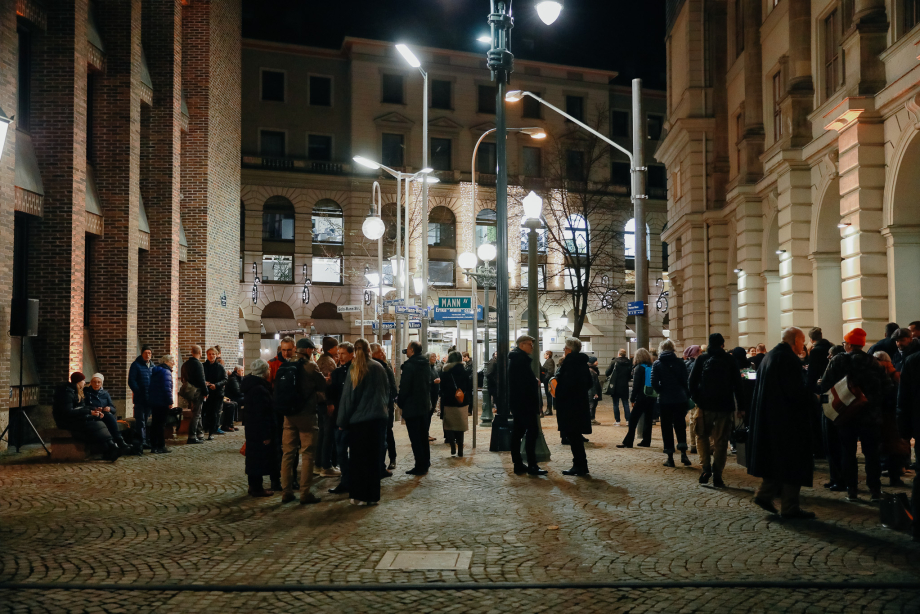
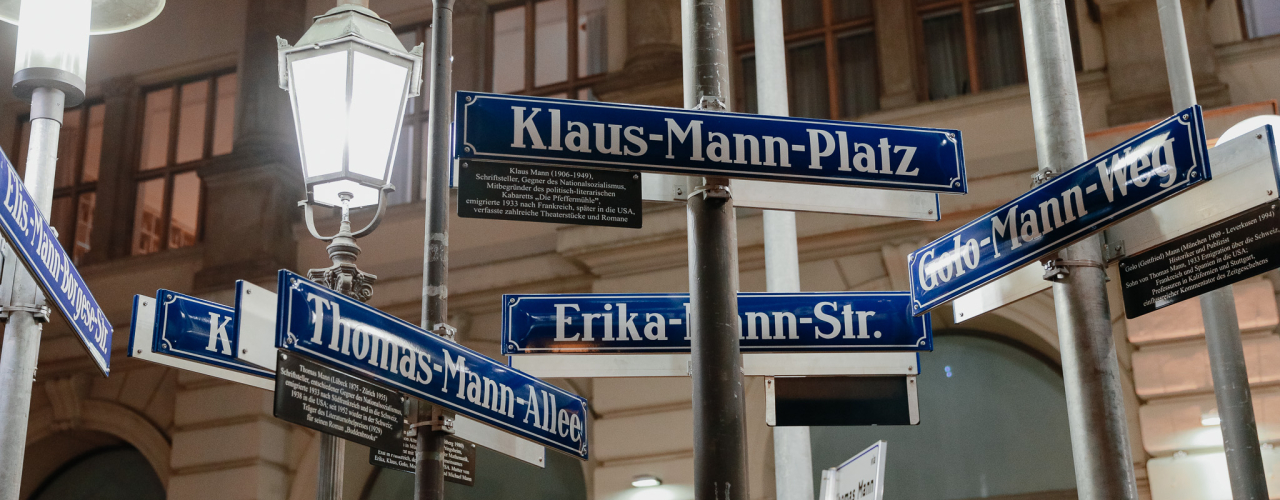
The “Straßen Namen Leuchten” (“Streets Names Streetlights”) project by Albert Coers creates a place of remembrance in the public space of the City of Munich for the Mann literary family – the Nobel prize winner Thomas Mann, his wife Katia, and their children Klaus, Erika, Golo, Elisabeth Mann Borgese, Michael and Monika Mann – fittingly, in the year that marks Thomas Mann’s 150th birthday.
The artwork consists of signs from streets and squares in Munich, Frankfurt, Zurich, Rome, São Paulo and other places that are named after members of the family, as well as streetlights from places where the Manns lived or found themselves in exile, such as Lübeck, Nida, Sanary-Sur-Mer, New York, Los Angeles and Kilchberg.
These elements reflect the internationality of the family, whose members lived and worked in Europe, the USA and South America, and they highlight the worldwide literary influence and significance of this family of writers. At the same time, the motif of the streetlight evokes associations with the literary, political and social influence of the Mann family’s life and work and alludes to the sentence “Munich was radiant,” with which Thomas Mann began his novella “Gladius Dei.”
A location was found in the heart of the city, directly at Munich’s Literaturhaus. This project aims to create an anchor here for the Manns’ biographies, while acknowledging the responsibility that the City of Munich bears with regard to their forced exile during the Nazi regime.
Albert Coers, born in 1975 in Lauingen, lives and works in Berlin and Munich.
The Mann Family Memorial Inaugurated
On December 9, 2025, the memorial “Streets Names Streetlights” by artist Albert Coers, dedicated to the Mann family, was officially inaugurated at Salvatorplatz in Munich. The memorial, commissioned by the City of Munich, explores the biographies of Thomas Mann, his wife Katia, and their six children.
Their life story, including their forced escape from Munich in 1933 and subsequent exile, represents an important chapter in Munich’s cultural and historical narrative. It also symbolizes the dark chapters in the city’s history during the Nazi regime’s rise to power, when Thomas Mann, his wife, and their children were forced to flee their Munich home in 1933.
In the initial demands for a memorial that were addressed to the City of Munich, the memorial was intended to honor the Nobel laureate in Literature, Thomas Mann. The relevant expert panels recommended expanding the scope of the memorial to include his wife Katja and their children Klaus, Erika, Golo, Elisabeth, Michael, and Monika Mann, which formed the basis of the call for proposals for the art project.
Some critics have pointed out that Heinrich Mann, Thomas Mann’s prominent brother and a world-renowned writer, was not included in the call for proposals for the memorial. However, this fact is by no means intended to diminish his life and work. The expert panels decided to focus on the aforementioned group because the forced exile from the state capital in 1933—with all its associated hardships—was a crucial factor. Munich, once a center of German culture and intellectualism, became a place of alienation and suffering for the Mann family.
Therefore, their stories of exile are central to Albert Coer’s memory project “Streets Names Streetlights”.
The work is an arrangement of lamps from Los Angeles, Nida, Sao Paulo, and Rome, each combined with a street sign bearing the name of a member of the Mann family. This highlights their places of activity in Europe, the USA, and South America, while simultaneously documenting the Manns’ global literary significance.