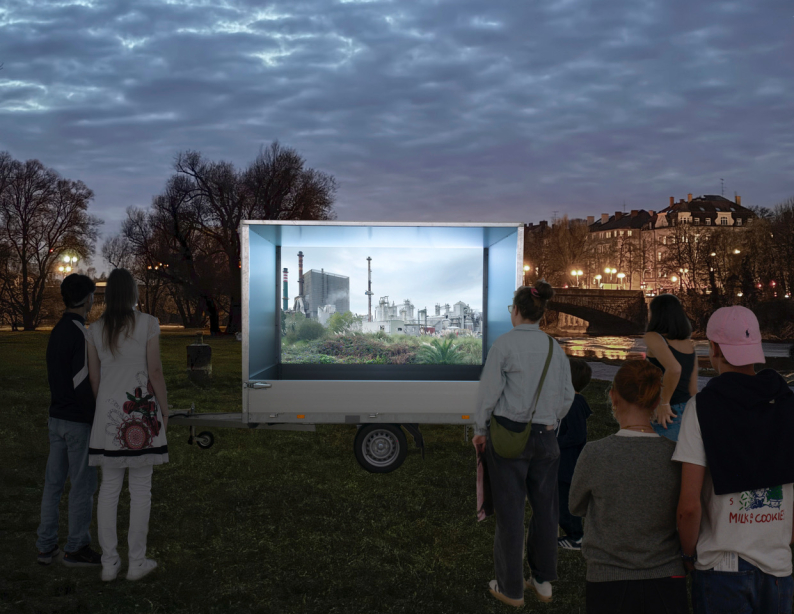


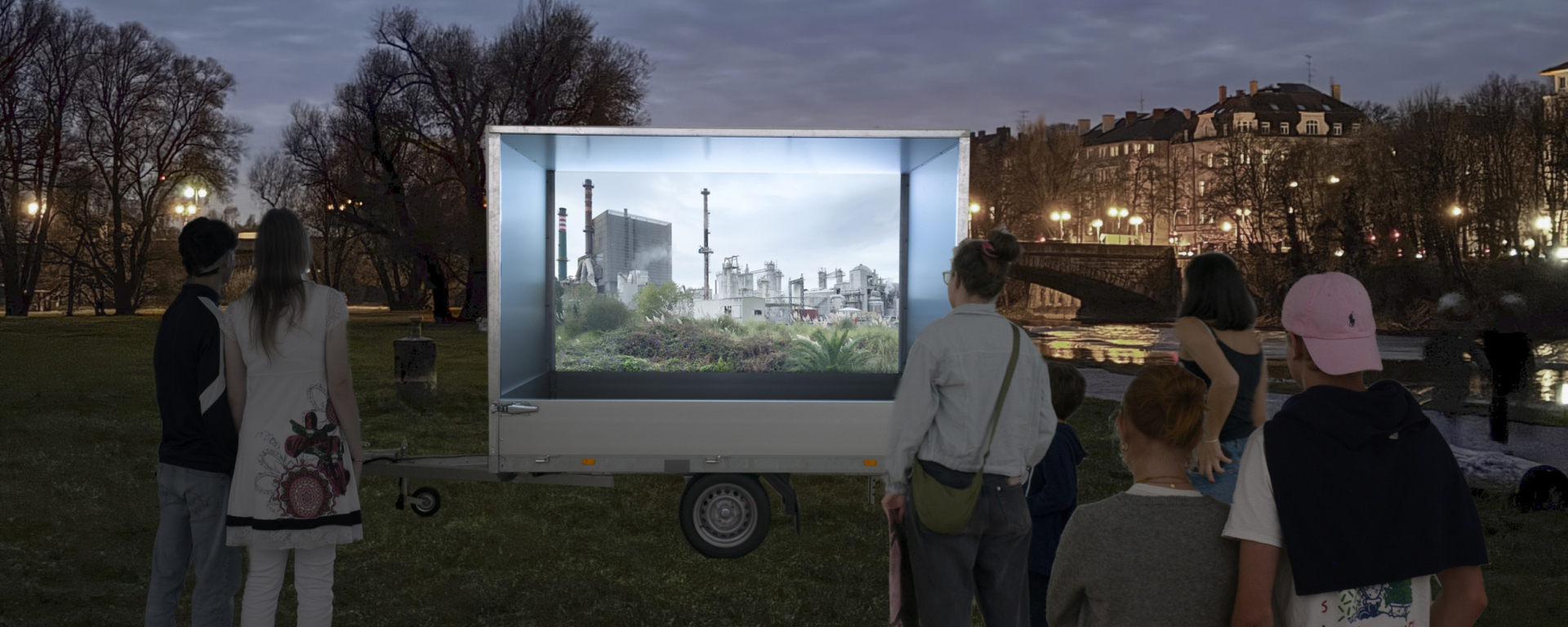
“Flussabwärts denken” (Think downriver) takes place over three evenings in July, titled “Source”, “Shore”, “River mouth”. Films by Stefanie Zoche are shown on the Videomobil, a converted car trailer. Invited guests from the worlds of literature, academia, and law will “think downriver” in performative collages in front of this mobile stage: they will examine the consequences of our actions on rivers. In the past, rivers provided for us and carried away our waste. They were the veins of the landscapes and the intestines of the settlements. They served us selflessly, but then came an era in which they were forced to serve—and the end of this era is still nowhere in sight.
Music: Sebi Tramontana and Evi Keglmaier
Stefanie Zoche, born in Munich, lives and works there.
Claus Biegert, born in Murnau, lives and works in Uffing at Staffelsee.
Program
Saturday, 11 July, 9:00 pm
Author Ilija Trojanow and journalist Kathrin Hartmann will come together for a conversation about sources. Every trickle has a source (Quelle), and so does every piece of information. Sources can be tainted, and information can be false. In the age of AI, the sources of our knowledge are becoming increasingly blurred. And the raw material sources of our prosperity are not inexhaustible, even if the concept of limitless growth suggests otherwise. The Supply Chain Act—constantly under attack from the right—was created to point the way back to the source. Looking back to the sources is indispensable if we want to take responsibility downstream.
Meeting point: Rotsteinufer, northeast of Flaucher
Thursday, 16 July 16, 9:00 pm
The shore (Ufer) is the very embodiment of diversity, a space where encounters resonate. Shores signal the presence of water. Without shores, there is no land; without shores, there is no river. The shore is a unique ecosystem, a threatened region, a neglected zone. What narratives block our view of unknown shores? And how did the fertile soil that nourishes us come to be in the first place? With these questions, Anita Idel and Torsten Schäfer take the stage. She, an agricultural expert and mediator between water, soil, humans, and animals, speaks about co-evolution between large herbivores and grasses, as well as the importance of microorganisms in cow saliva for humus formation; he, a wilderness educator and professor of journalism, speaks about the forest-dwelling salmon and rivers as living beings.
Meeting point: south of the Braunau railway bridge
Thursday, 30 July, 9:00 pm
The river mouth (Mündung) is dedicated to our relationship with the dimension of time. Here we encounter the writer Gert Heidenreich, who, in his declaration of love to “Frau Atlantik”, confronts the toxins of eternity that our industrial society discharges downstream into the oceans. Heidenreich contrasts our conception of time with the Iroquois principle of the seven generations: Whatever we do today must not jeopardize the well-being of the next seven generations. In dealing with nuclear waste, our civilization has created a presumptuous measure of time: we are talking about millions of years here; one could speak of a plutonium era, a tributary of the Anthropocene. Cultural anthropologist Jenny Garcia Ruales from Ecuador will explain the constitutional amendment in her home country. In 2008, Ecuador granted nature—or Pachamama—its own rights in its constitution. Pacha refers to a cosmos that encompasses both time and space, and embodies the responsibility of us Earthlings, similar to the Iroquois concept.
Meeting point: north of the Braunau railway bridge
In case of rain, the events will take place under the Wittelsbacher Bridge. This information will be posted on our event calendar on the day of the event.