
Raumfragen e.V. develops participatory art projects that explore, reclaim, and reinterpret public space in collaboration with its users. The focus is on the question of how places can be perceived differently through collective action. Rather than viewing urban space as an immutable structure with fixed social inscriptions, Raumfragen conceives of it as a living place whose meaning can be renegotiated again and again. The billboard project “Animal Neighbourhood” takes up this approach through two motifs developed specifically for this purpose in Neuperlach.
Neuperlach is often associated in the public perception with the cliché of gray prefabricated housing estates. Yet between the buildings lies a dense network of meadows, trees, paths, and courtyards—habitats that shape the neighborhood just as much as its architecture. The billboard draws attention to these green spaces and to the diverse living creatures that share this neighborhood.
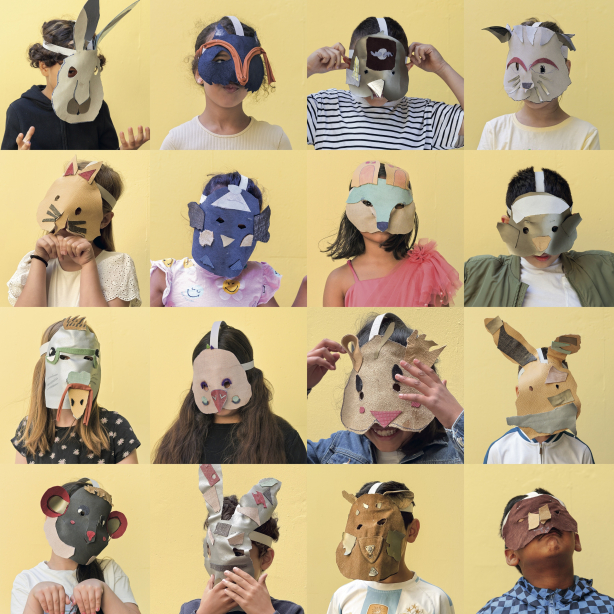
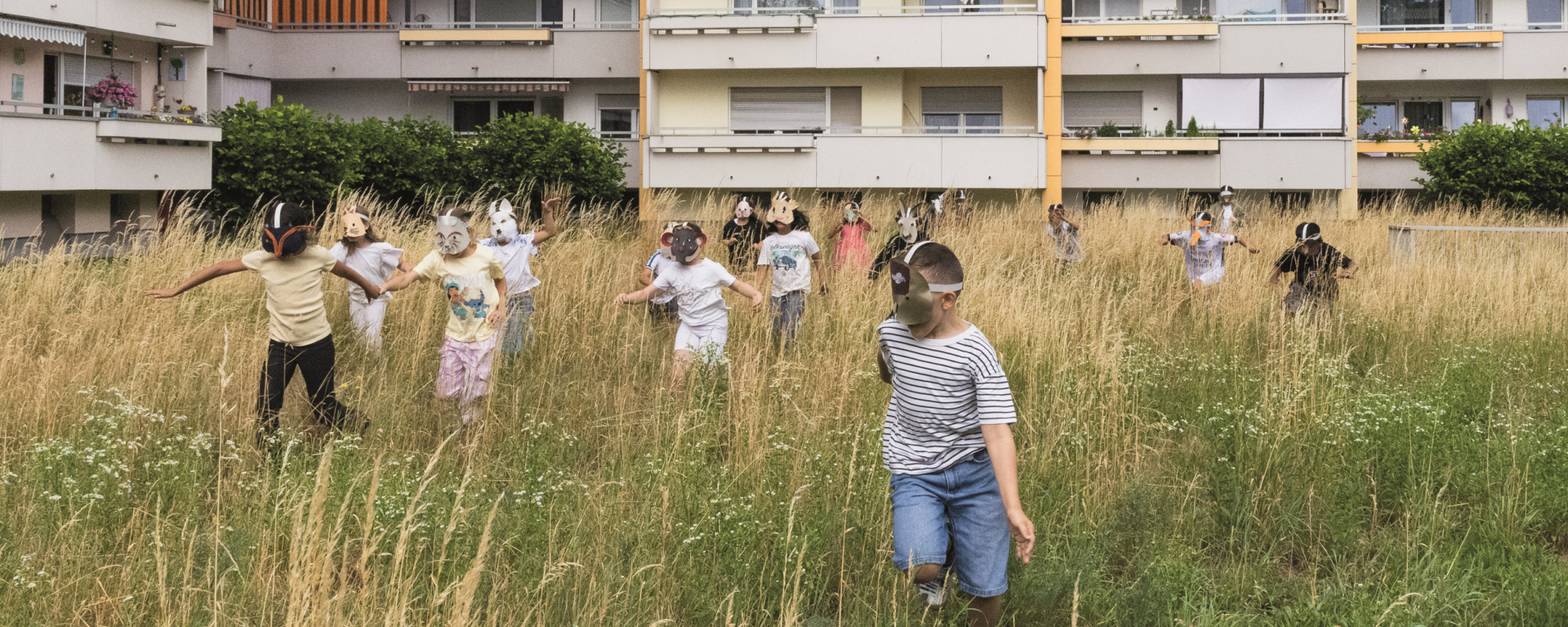
The project began with a two-day workshop with an elementary school class led by artist and Raumfragen member Verena Seibt. The children designed abstract animal masks and created their own animal creatures with unique characteristics to go with them. In a story created specifically for this project, these characters become the “Neuperlach City Animals”—creatures that perceive the neighborhood from a different perspective than we humans do.
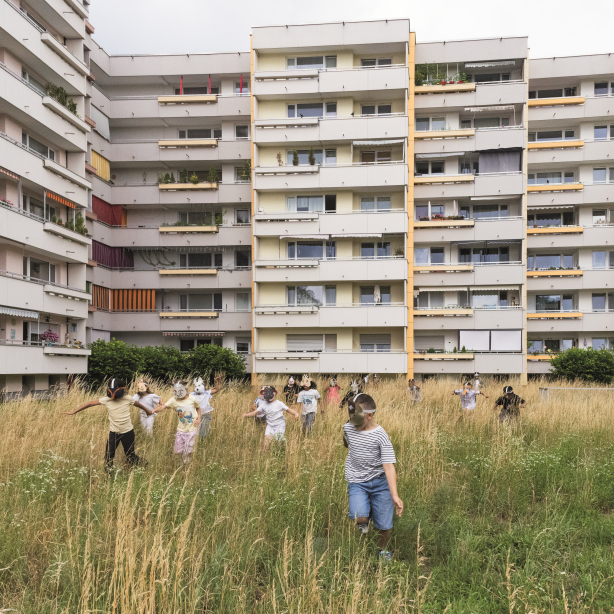
On the second day of the workshop, the children moved through public spaces as their animal characters. Playful activities such as “The Floor Is Lava,” “Ochs am Berg,” and an “animal gathering” provided opportunities to explore squares, paths, and green spaces in the immediate vicinity of the school. These locations were not merely used as settings, but were temporarily taken over through shared play and reinterpreted in photographs.
The visual composition combines two levels: A grid of portraits showcases the diversity of the individual animal creatures and their personalities. This grid is complemented by large-format photographs in which the children, as mythical creatures, roam the urban landscape. Between individual identity and the collective appropriation of public space, a multifaceted portrait of Neuperlach is created.
The billboard is intended as an invitation to see the neighborhood through a different perspective. It does not portray Neuperlach as a concrete landscape, but rather as a living space where architecture, vegetation, animals, and people are inseparably linked. The children’s perspective opens up a view of public space that is shaped by imagination, appropriation, and collective action.